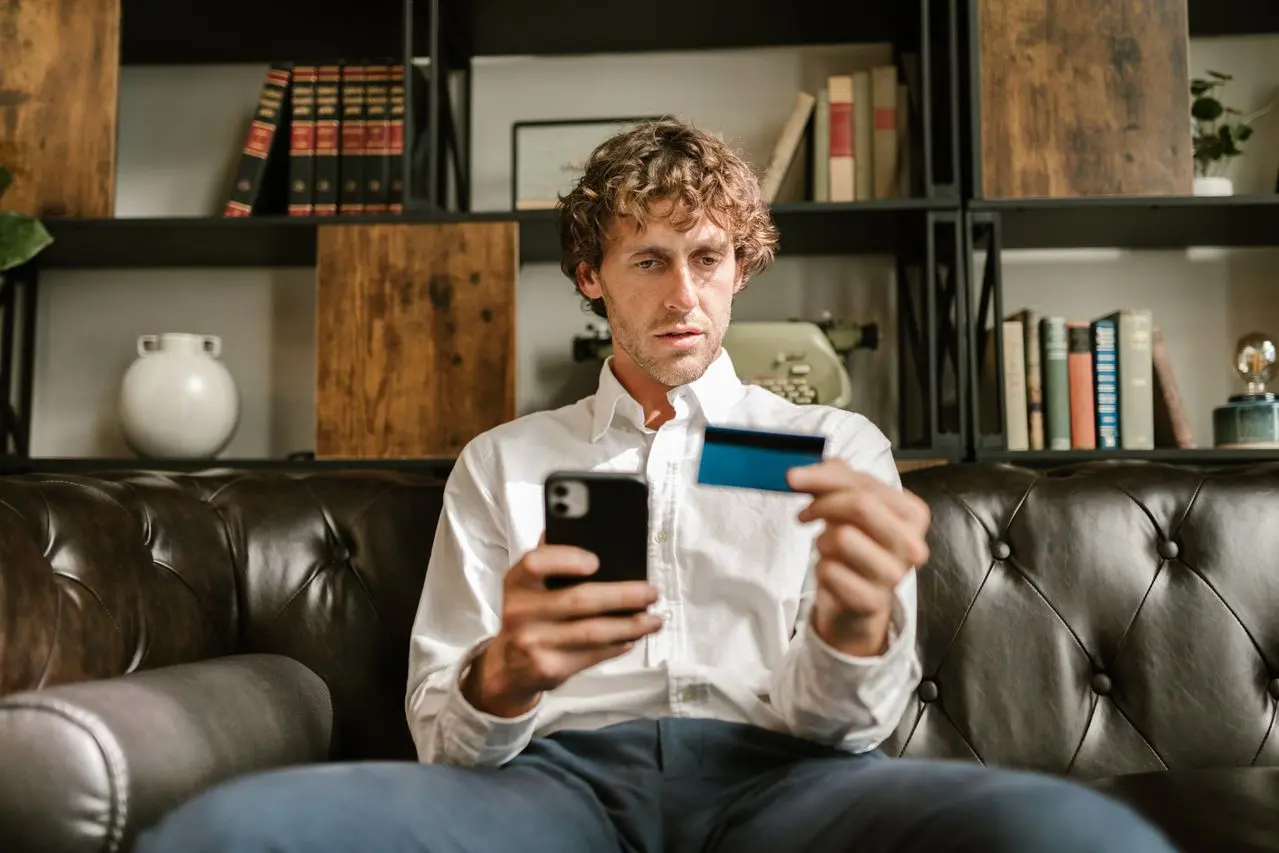
When you pay with cash in a shop, something in your brain registers a small discomfort. Researchers call it the pain of paying, and it is real in the most literal sense: neuroimaging studies show that the act of parting with money activates the insula, the same brain region associated with physical pain and disgust. It is not a metaphor. It is a physiological response.
That mechanism exists for a reasonable evolutionary reason: money represents resources, and losing resources is a threat to survival. The problem is that the modern financial world has learned to deactivate it systematically, with direct consequences for how much we spend without realising it.
What exactly is the pain of paying
The pain of paying was first described systematically by behavioural economists Drazen Prelec and Duncan Simester in 2001. Their experiments showed that people are willing to pay significantly more for the same product when using a credit card than when paying cash. The reason is not rational: the product is worth the same. The reason is that cash makes the cost more visible, more tangible. And that visibility hurts a little, just enough to make you think twice.
The pain of paying is not constant. It varies depending on the payment method, the temporal proximity of the charge and the visibility of the cost. This table shows how it behaves across the most common payment methods:
| Payment method | Pain level | Why |
|---|---|---|
| Cash | High | Notes are physical, visible and leave your hand |
| Debit card | Medium | The charge is immediate but there is no physical contact with money |
| Credit card | Low | The real payment is delayed by weeks, disconnecting consumption and cost |
| Mobile payment | Very low | A gesture in a fraction of a second, with no perceptible friction |
| Automatic subscription | Almost zero | The charge happens with no conscious action from the user |
How the modern world has eliminated the pain of paying
The entire architecture of modern commerce, especially digital commerce, is designed to reduce the pain of paying to a minimum. It is not a conspiracy: it is a perfectly rational business incentive. The less paying hurts, the more people buy.
The most effective techniques for achieving this are well known and deliberate:
- One-click payment: eliminates steps and reflection time. Amazon popularised it in the 90s and changed e-commerce forever.
- Automatic subscriptions: the monthly charge becomes so routine that it stops being perceived as an active payment.
- Virtual tokens: converting real money into credits or virtual currency weakens the emotional connection to its value. Casinos discovered this decades ago with chips.
- Fragmented pricing: showing "$9.99 a month" instead of "$119.88 a year" reduces the perception of the real cost.
- The free trial: when the charge starts after you have already enjoyed the product, the pain is deactivated at the moment of decision.
Subscriptions: the most extreme case
Subscriptions are the financial product that has best exploited the disappearance of the pain of paying. A monthly charge of $9.99 on a linked card generates practically zero pain, especially if the service has been active for months and the charge feels like something that simply happens.
The result is predictable: people accumulate active subscriptions they no longer use because cancelling requires a conscious action that the automatic charge never triggers. Some figures on this phenomenon worth bearing in mind:
- Consumer studies in the United States estimate the average household spends over $200 a month on active subscriptions.
- Most people significantly underestimate how much they spend on subscriptions when asked before reviewing their statements.
- Platforms deliberately design the cancellation process to be harder than signing up.
The monthly financial review is the most effective antidote: once a month, review every recurring charge and actively decide whether each service is worth keeping.
The pain of paying is not a brain defect: it is a protection system. The problem is not that it exists, but that the industry has learned to deactivate it so effectively that most people have lost the warning signal that system provided. Recovering it deliberately is one of the most practical ways to improve control over spending.
The effect on real spending: what the data says
Studies on the impact of payment method on buying behaviour consistently point in one direction: paying without cash increases spending. The numbers are more striking than most people would expect.
In Prelec and Simester's original experiment, participants bid twice as much for event tickets when paying by card than when paying cash. An MIT study found that consumers spend between 12% and 18% more with a credit card than with cash at the same supermarket. And people who use mobile payment apps consistently report lower awareness of how much they have spent in a given period.
These effects are not uniform for everyone or for every spending category. But the trend is clear: the more abstract and deferred the payment, the more is spent. See the article on why we spend more than we plan for the broader psychological framework this phenomenon sits within.
How to use the pain of paying to your advantage
If the modern financial system works to reduce your pain of paying, the opposite strategy is to add it deliberately where it has the most impact. Not for every purchase, but for the categories where spending tends to get out of hand.
| Strategy | Where to apply it | What it achieves |
|---|---|---|
| Audit subscriptions monthly | All recurring charges | Makes visible the charges that automation renders invisible |
| Use cash or debit for problem categories | Leisure, clothing, eating out | Adds friction and visibility where spending most tends to run over |
| Enable real-time spending notifications | Bank or card app | Recreates part of the pain eliminated by digital payment |
| Remove saved card details | Online shops and shopping apps | Adds friction at the moment of greatest impulse |
| Convert prices into hours of work | Non-essential high-value purchases | Makes the emotional cost more concrete and real |
See the article on impulse buying for more strategies that complement this approach.
The pain of paying and automatic saving: the most powerful application
The same principle that causes subscriptions to accumulate painlessly can be used in reverse to save. Automatic saving works precisely because it eliminates the pain of setting money aside: when the transfer happens on payday, automatically, before the money is available to spend, there is no conscious decision to make and therefore no pain to overcome.
It is the same psychology that subscription platforms use, applied to your own benefit. The automatic saving charge normalises over time just like any digital service charge: it stops feeling like a loss and starts feeling like part of the normal financial landscape.
Understanding the pain of paying means recognising that the brain has a financial alert system that works well, that this system is being deliberately deactivated by the environment, and that recovering that signal consciously is one of the most accessible tools for spending better without needing more discipline. Well-designed systems do not require heroism. They just require that you understand how the game works.